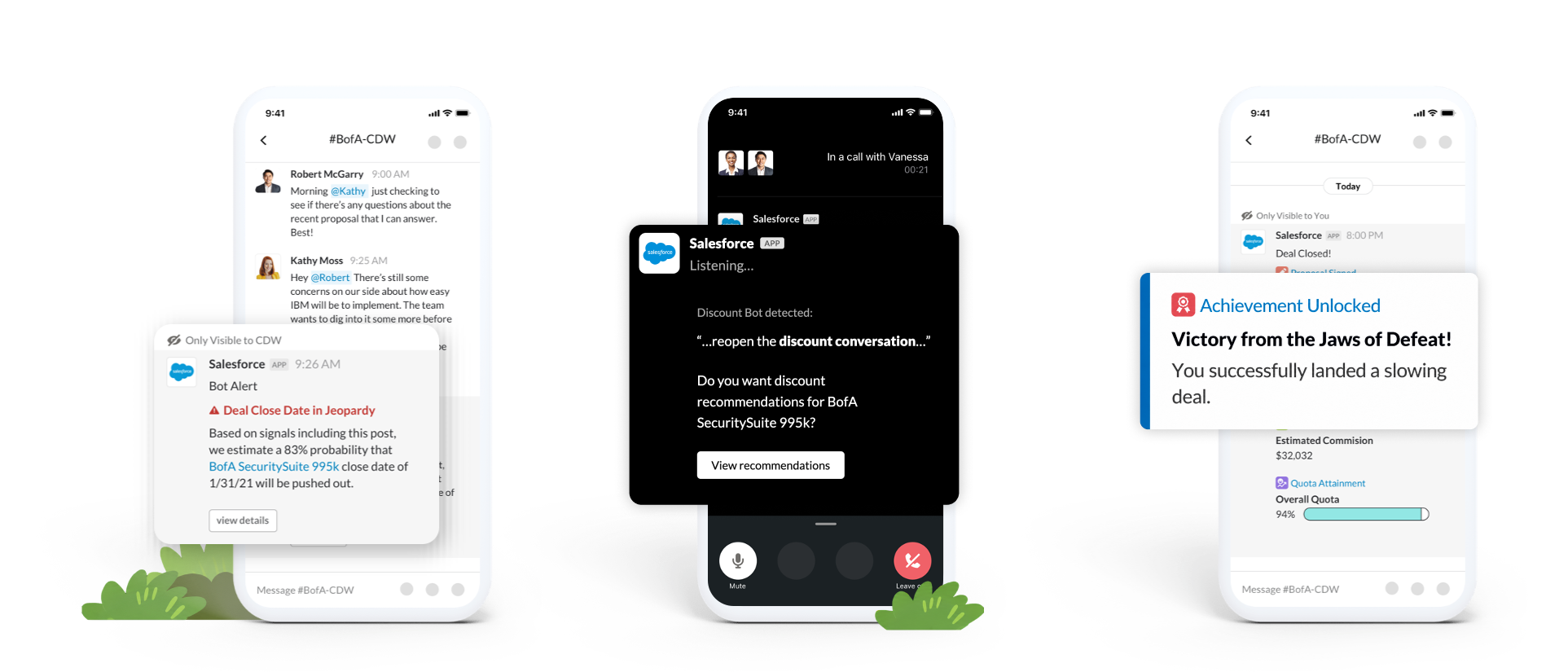
Executive Summary
Selling in Slack: Visualizing a Future for Salesforce + Slack
Company
Salesforce, Sales Cloud UX
Timeline
One week; presented February 2021
Format
Narrative concept exploration
My Role
Design lead, four-person team
The Problem
Salesforce announced its intent to acquire Slack in December 2020. Product executives had no picture of what the deal meant for their lines of business, but the price tag left no doubt it would matter.
No brief came down, so we brought sales leadership a use case: what would selling look like if it ran on Slack’s conversational surface, powered by the customer data and insights already sitting in Salesforce CRM? The organization did not need a roadmap. It needed to see the experience rendered at enough fidelity to picture it and discuss it.
Outcome
- An illustrated future-state narrative putting Slack at the center of a seller’s motions with a customer, carried by Conversation Intelligence, which I led design for, and a cast of task-scoped bots that the industry would later call agents
- Five experience principles that gave leadership a shared vocabulary: swarm to win, empower the buyer, signals for action, ease the process, enable the seller
- Shaped how the team approached Slack and Sales Cloud together, and set up later waves on account management and seller presence
My Role
- Design lead on a four-person team drawn from Sales Cloud UX
- Structured the scenario and wrote the narrative
- Directed the visualization: which moments to show, from whose point of view, and at what fidelity
- Presented it as a provocation rather than a proposal, first to Sales Cloud leadership, then to senior leadership with Slack in the room
Detailed Case Study
Context and Challenge
Why This Problem Mattered
An acquisition that size creates a vacuum. Every product leader knows something is about to change and has no picture of what, so teams either freeze or default to the smallest interpretation. Ours was that Slack is a notification channel for Salesforce records.
The quick integrations needed to ship. They showed value immediately, which the moment called for, but they were not the long-term vision our leaders were asking for. So I started what I called “Wave 2”: a vision for the work past the obvious, and a way to steer the pieces still in flight.
Slack’s value to a sales organization was never that it could receive alerts. The actual work of selling (negotiating, swarming, pulling in a partner at the last minute) already happens in conversation, and Slack was where that conversation could live with the customer in it.
I was already leading design on Conversation Intelligence, which mined sales calls for competitor mentions, pricing talk, and sentiment. That is the insight layer running underneath this story. The intelligence in the concept extended a product line already in flight rather than something invented for the deck.
Our mandate in Sales Cloud UX was to serve sellers in their daily work. The challenge was making that work vivid enough that people would react to it.
What was not working
- The most consequential product question in the company was being discussed in the abstract
- Selling motions were split across CRM, email, meetings, and chat, with the record assembled after the fact
- The buyer sat outside every internal system, reachable only through the seller
What made this hard to explore
- Neither product’s roadmap could be assumed, and Einstein was still emerging
- Anything too polished would be read as a commitment; anything too rough would not travel
- A shared buyer/seller channel raises real questions about what each side should be allowed to see
Approach
Declare the Fidelity Before Anyone Asks
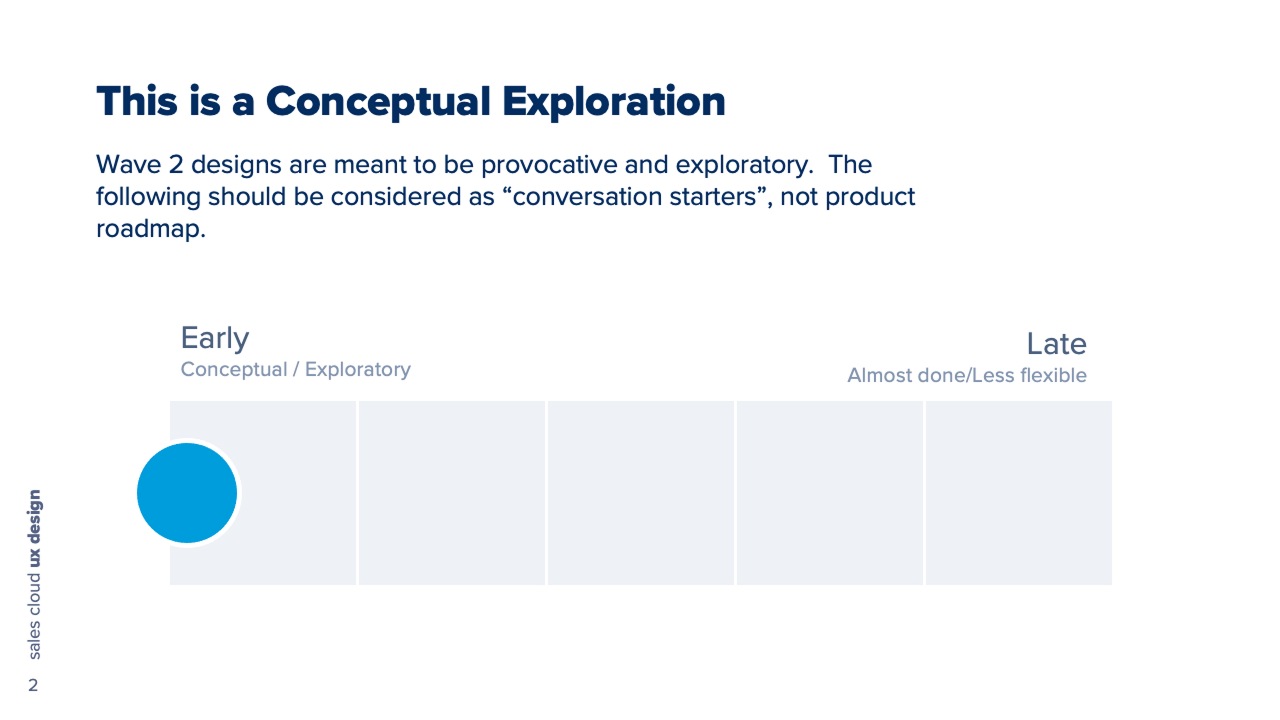
The fastest way to kill an exploratory concept in a large organization is to let someone mistake it for a plan. I opened the deck by placing the work on a fidelity scale: conversation starters, not a roadmap, and deliberately not bound by what Slack or Sales Cloud could ship that quarter.
That one slide earned its keep. It gave executives permission to react to the idea instead of interrogating its feasibility.
Declaring the fidelity up front
The first slide in the deck. Establishing where the work sat on the scale kept the conversation on the idea rather than on the schedule.
One Story Instead of a Feature List
There are a million stories in enterprise sales, and a survey of all of them would have persuaded no one. We chose one every sales leader in the room had lived: a deal starts to slip, and the team has days to save it.
The choice was emotional as much as structural. Every sales leader carries a deal they lost and still think about. We set out to show Slack preventing it.
A deal save also forced every capability we cared about to appear naturally: the buyer objects, the system notices, the manager swarms, a partner is pulled in, the paperwork closes. Nothing had to be justified on its own. It just had to earn its place in the story.
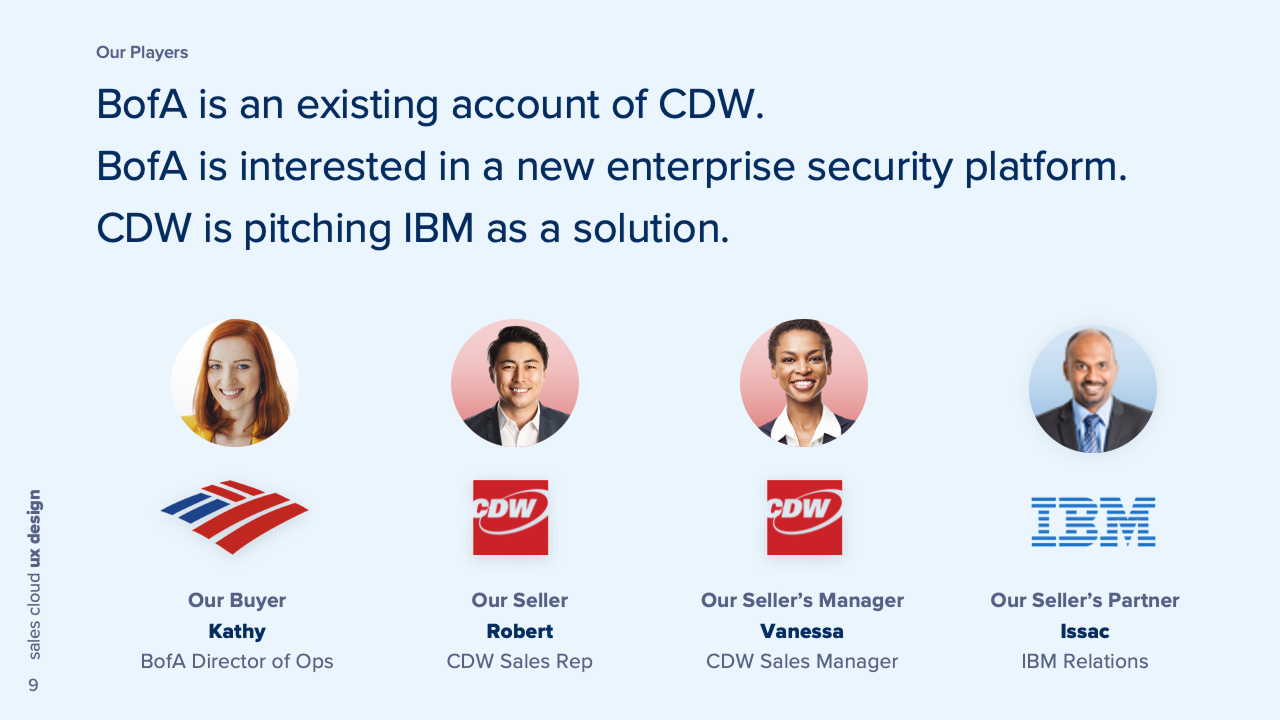
We cast four people and fixed the point of view, switching between the buyer’s screen and the seller’s so the gap between what each side sees became a design question rather than a footnote.
Our players
Four named people rather than four personas: the buyer, the seller, the seller’s manager, and the partner rep whose product is being sold.
We Called Them Bots Because Nobody Was Saying Agents Yet
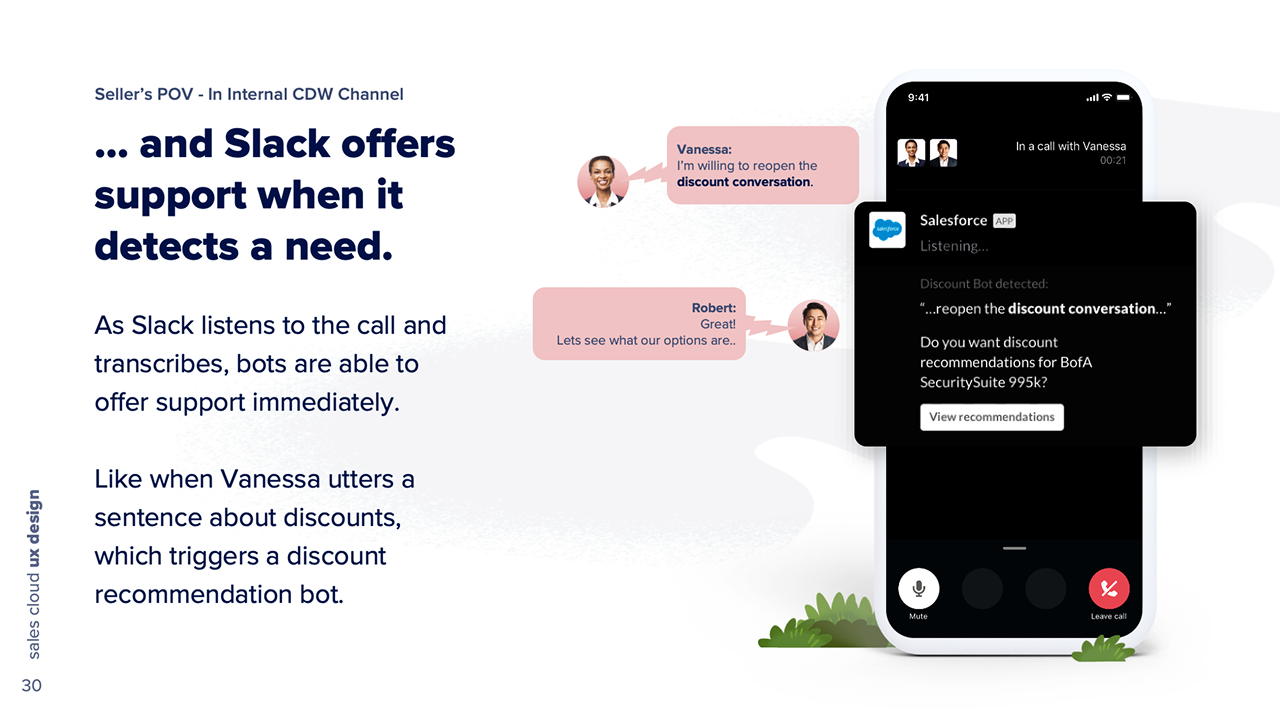
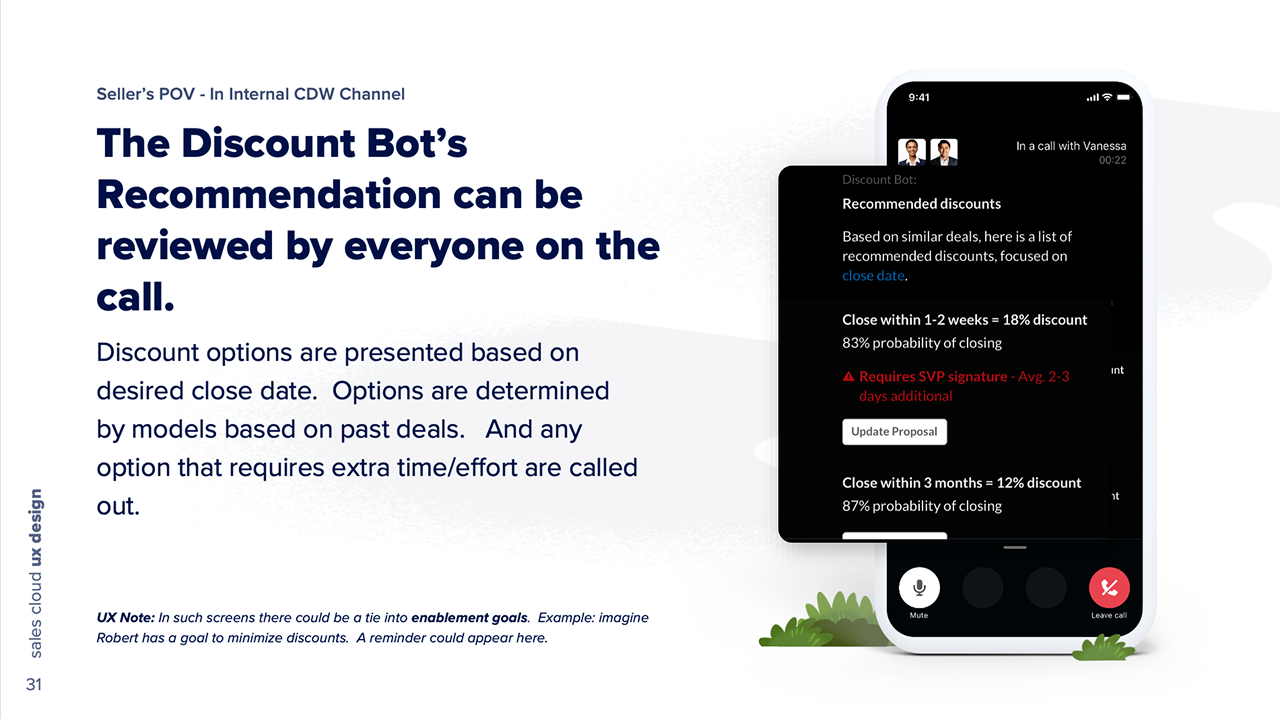
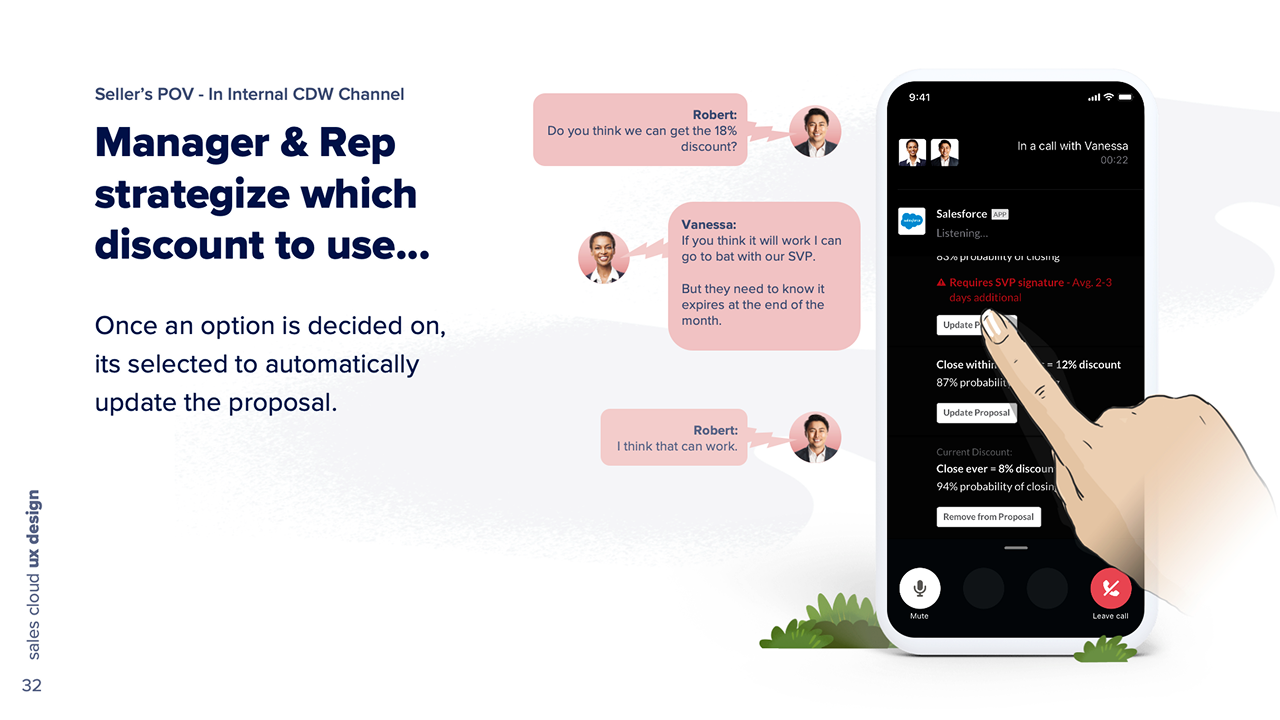
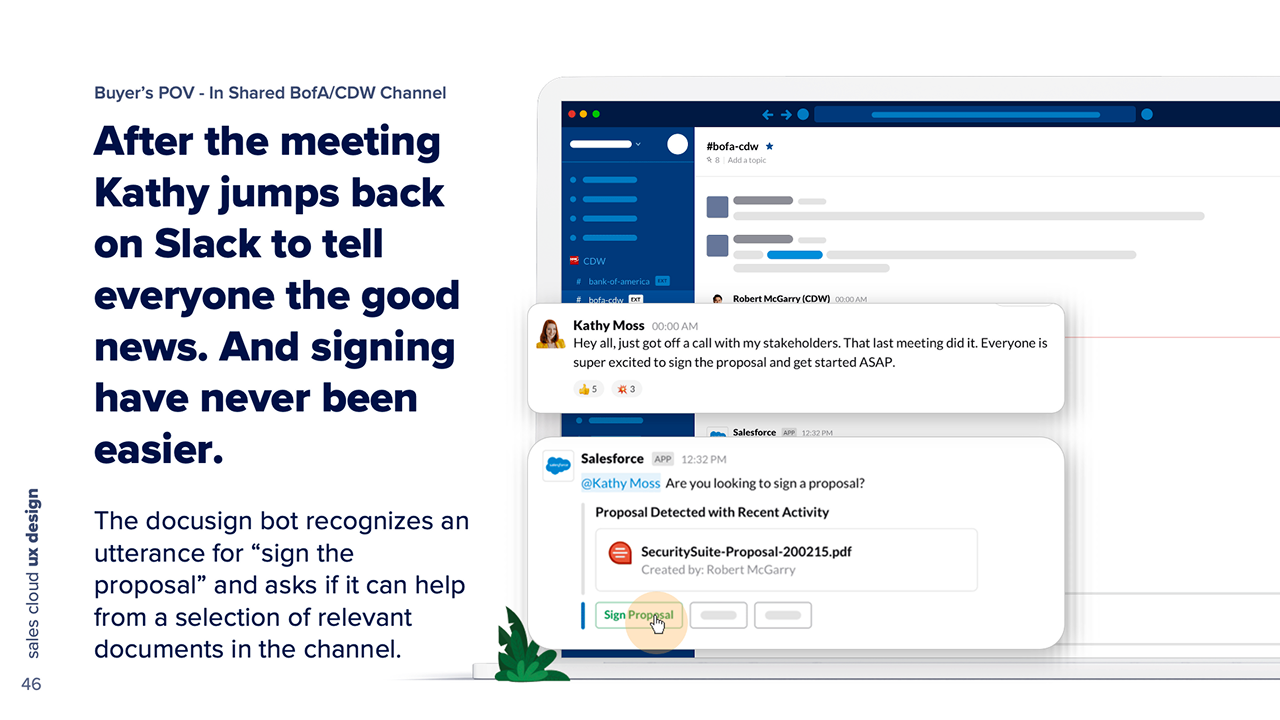
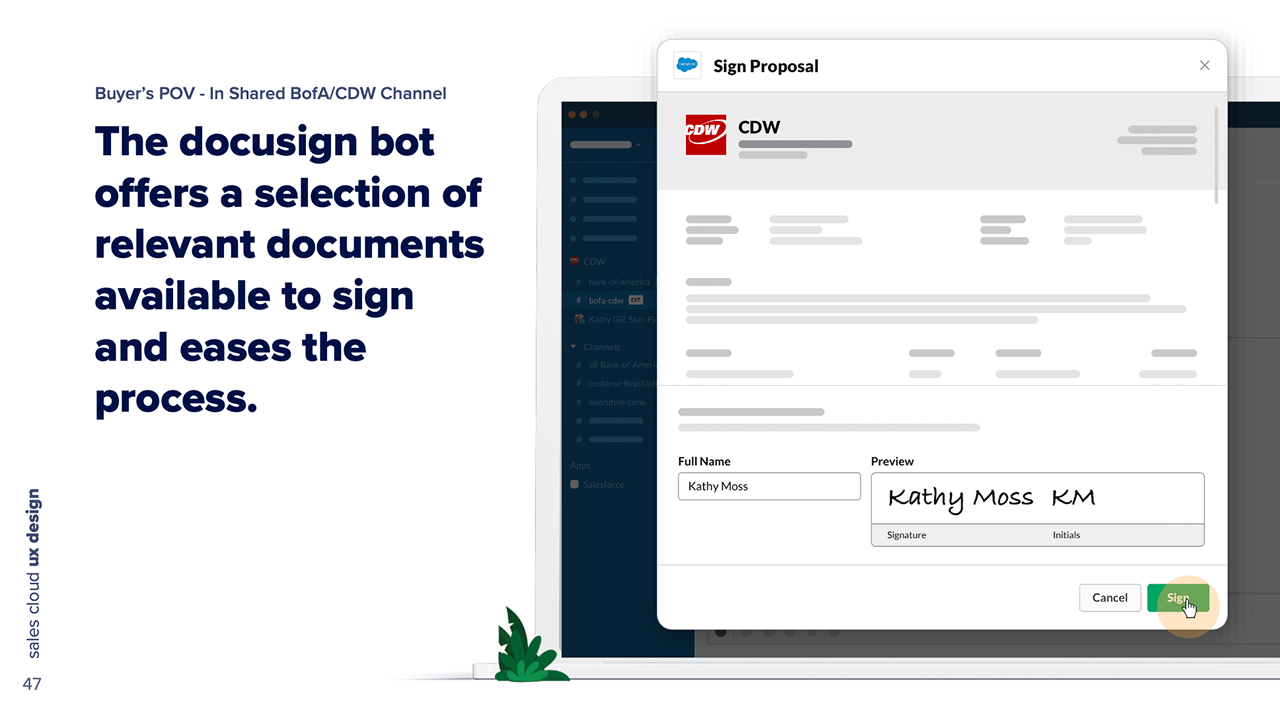
The system in this story is a cast of autonomous helpers. One evaluates deal health and escalates when a close date is at risk. One models discount options against past deals and writes the chosen one back to the proposal. One finds a time across four calendars. One hears an intent to sign and produces the right document. Today the word for that is agents. In February 2021 that word would have needed a paragraph of setup before anyone in the room could react to the idea.
So we called them bots. Slack users already knew what a bot was, and the familiar word bought the concept a hearing that the accurate one would not have. The choice was about vernacular, not architecture. What we were drawing was a seller working alongside a set of specialized agents, each scoped to one job and triggered by something said in the conversation rather than by a menu.
How we worked
- A brainstorm across Sales Cloud UX to surface candidate buyer/seller moments
- Scenario and narrative structure sketched with the team in a single pass
- Wireframes and visual comps produced against the script, not ahead of it
Rules we set
- Show the moment, not the feature
- Always name whose screen you are looking at
- Flag the open questions on the slide where they arise
What we left open
- Whether a buyer’s self-serve actions should be visible to the seller at all
- How seller-only insight sits inside a channel the customer is in
- Where enablement goals should temper a system recommendation
The Story
The concept runs as one continuous narrative in three acts: a deal slips in a channel shared with the customer, the manager and rep swarm on it in a call, and the group regroups the next day to close. What follows is the exploration as presented.
Act One: The Deal Starts to Slip
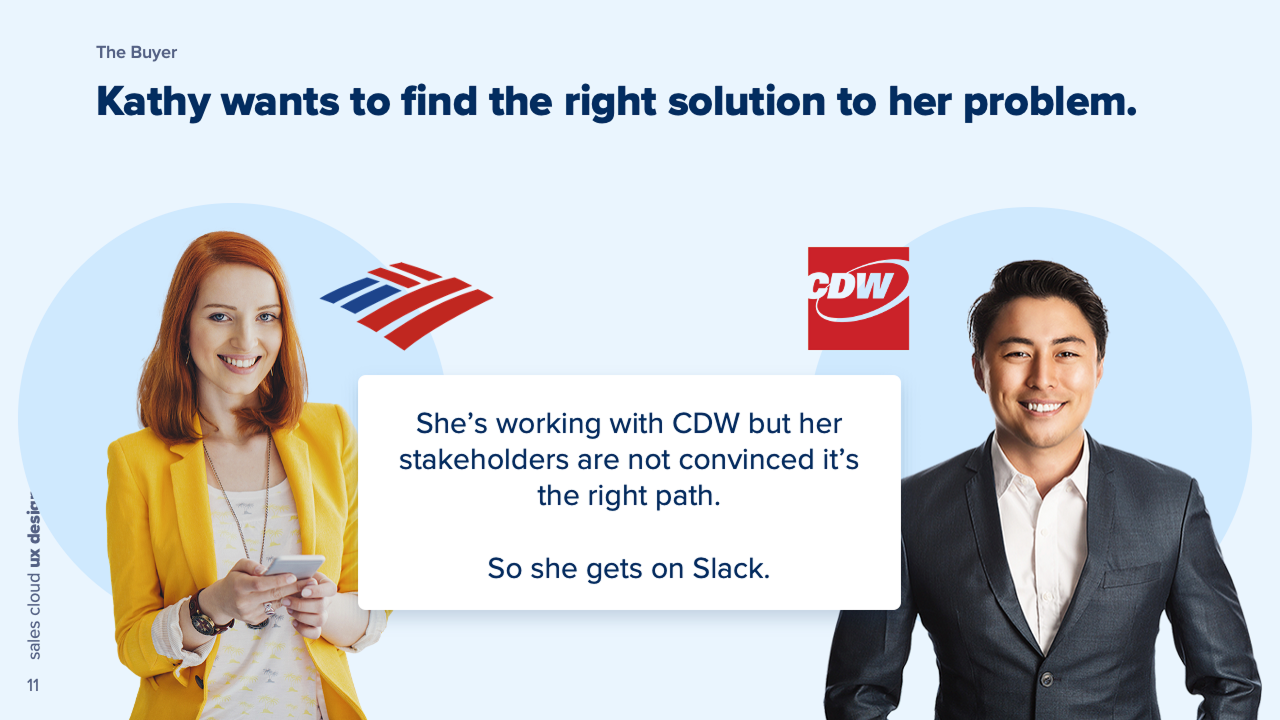
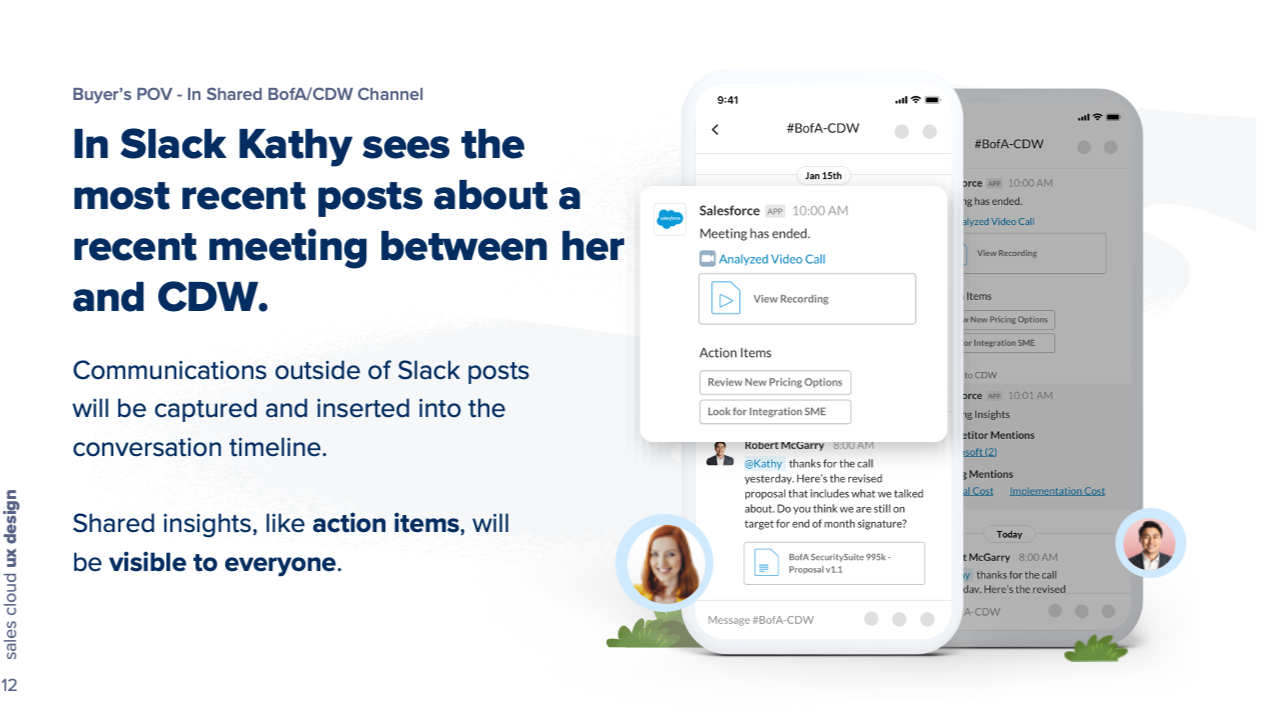
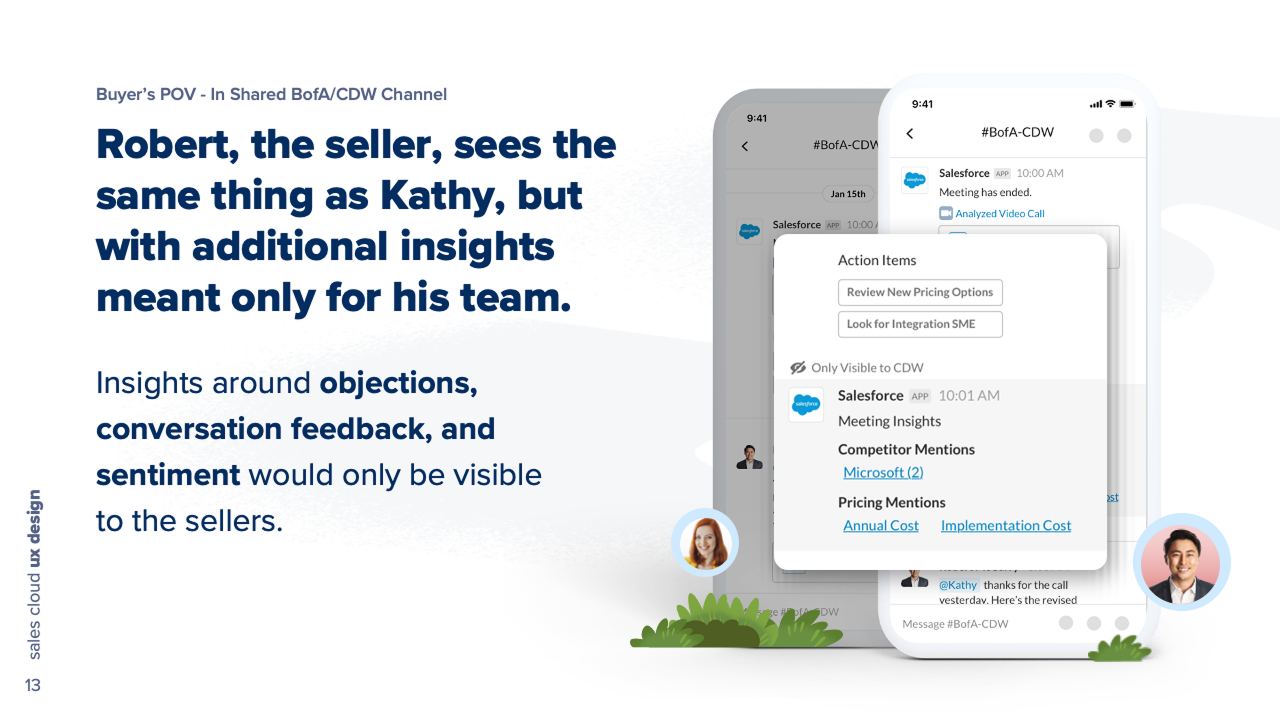
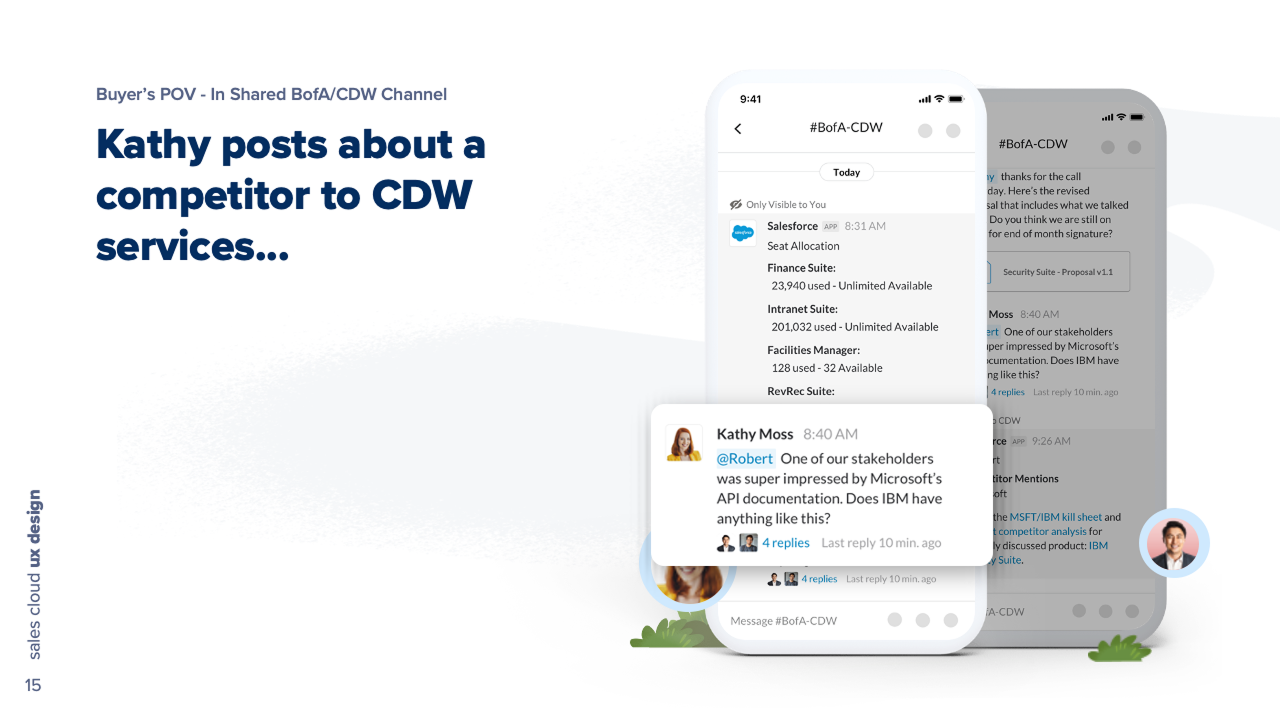
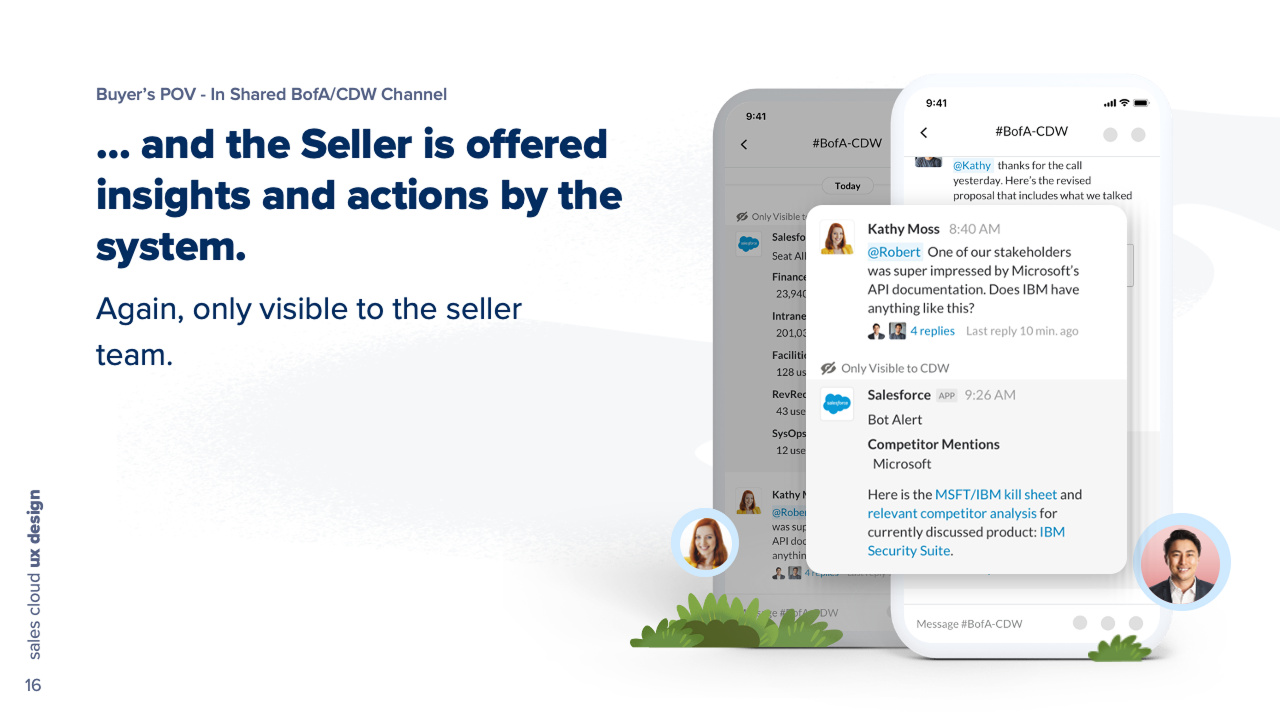
Buyer and seller share a channel. They see the same conversation, but the seller’s view carries a layer of insight the buyer never sees, and that layer is what catches the deal going sideways.
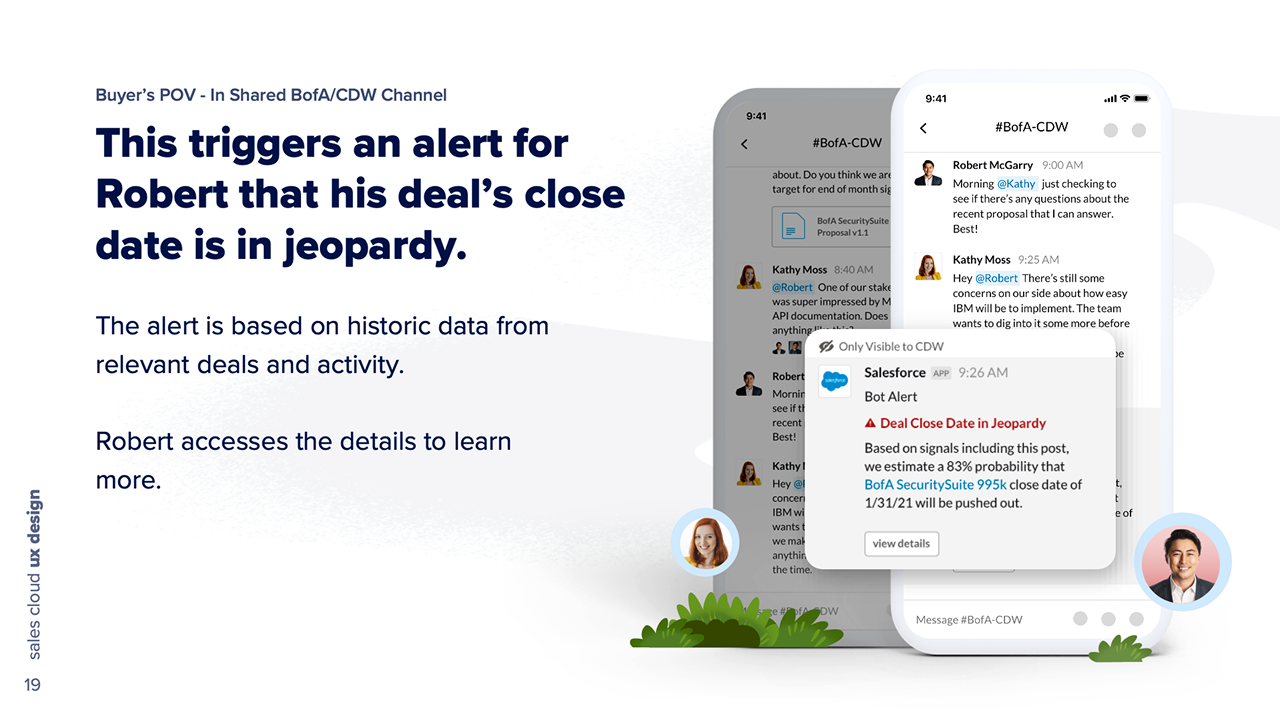
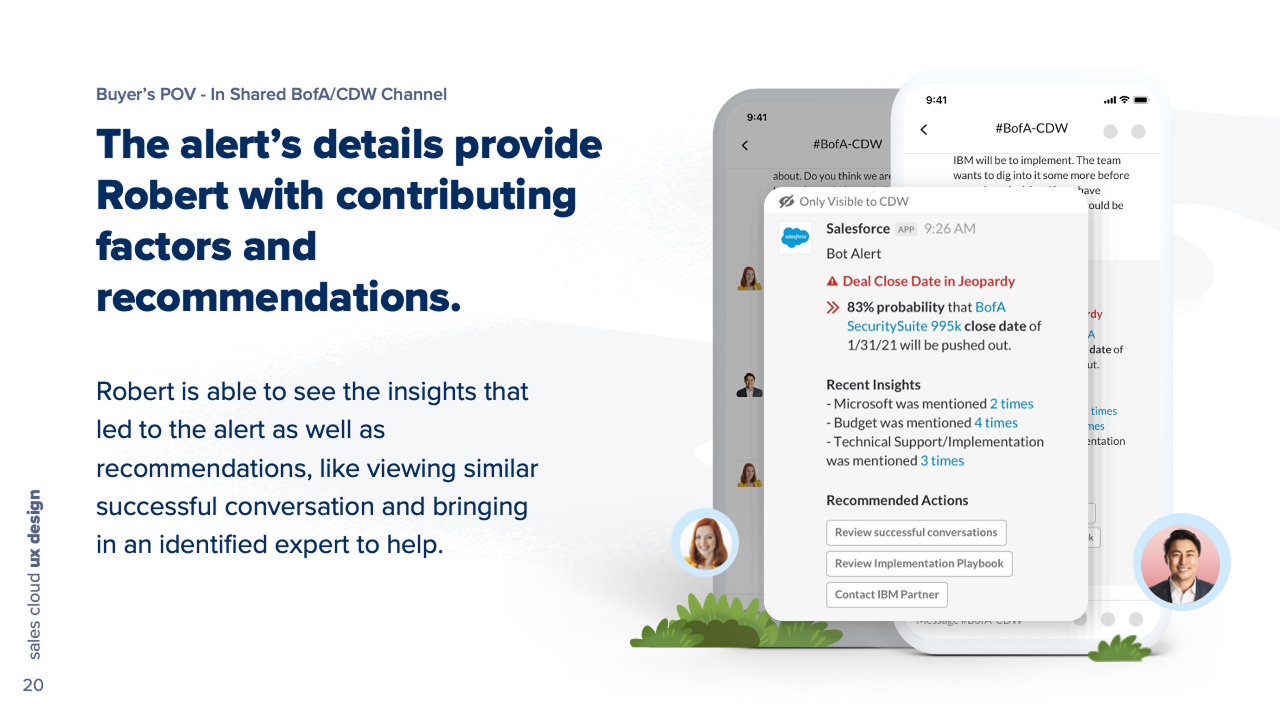
Act Two: The Swarm
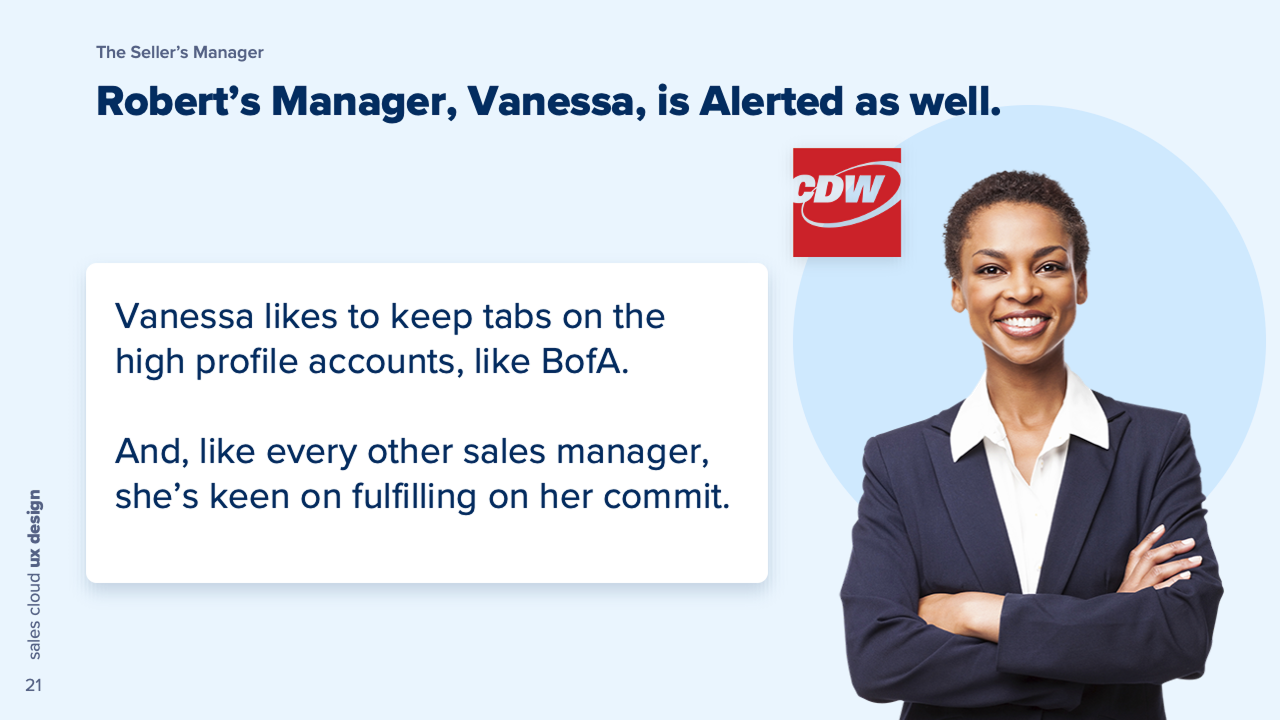
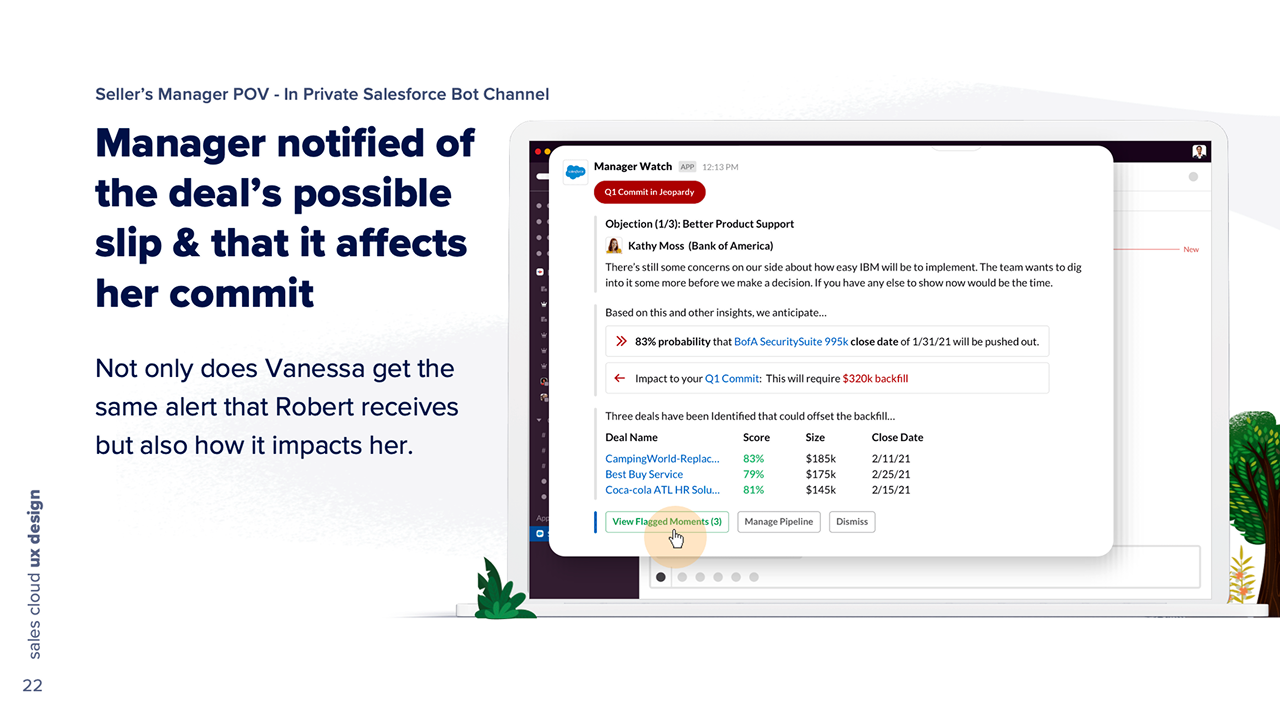
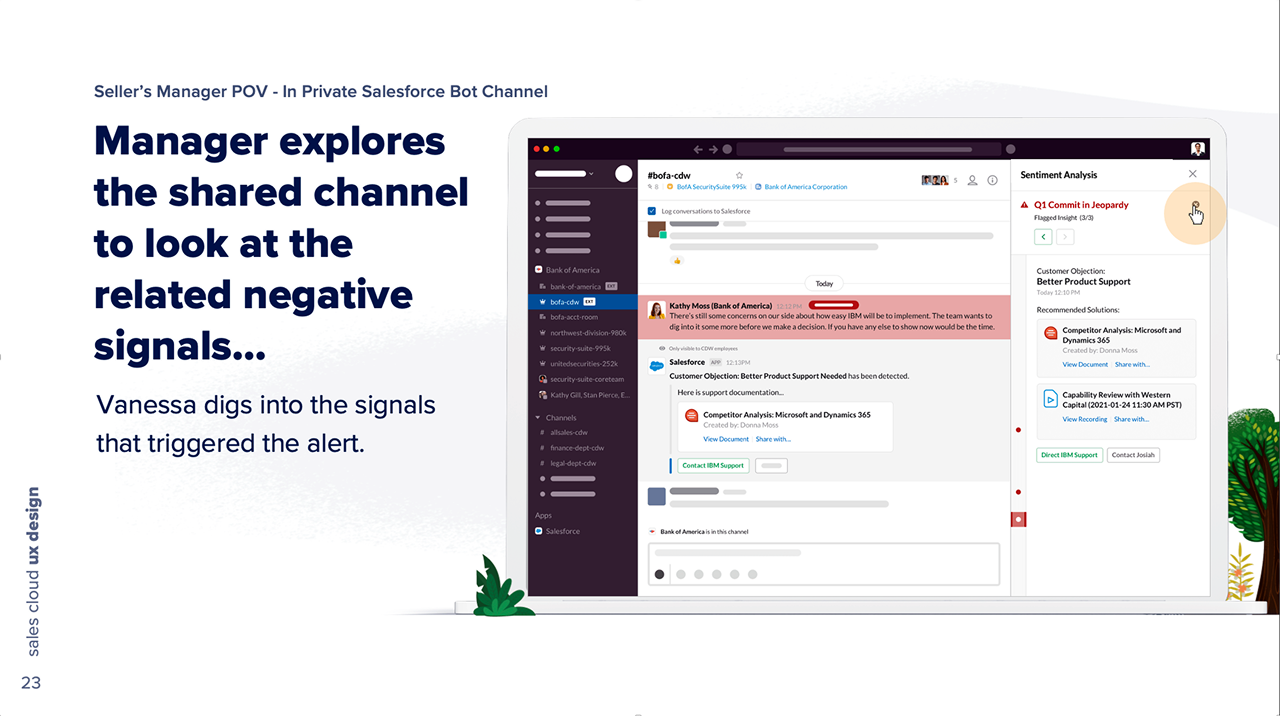
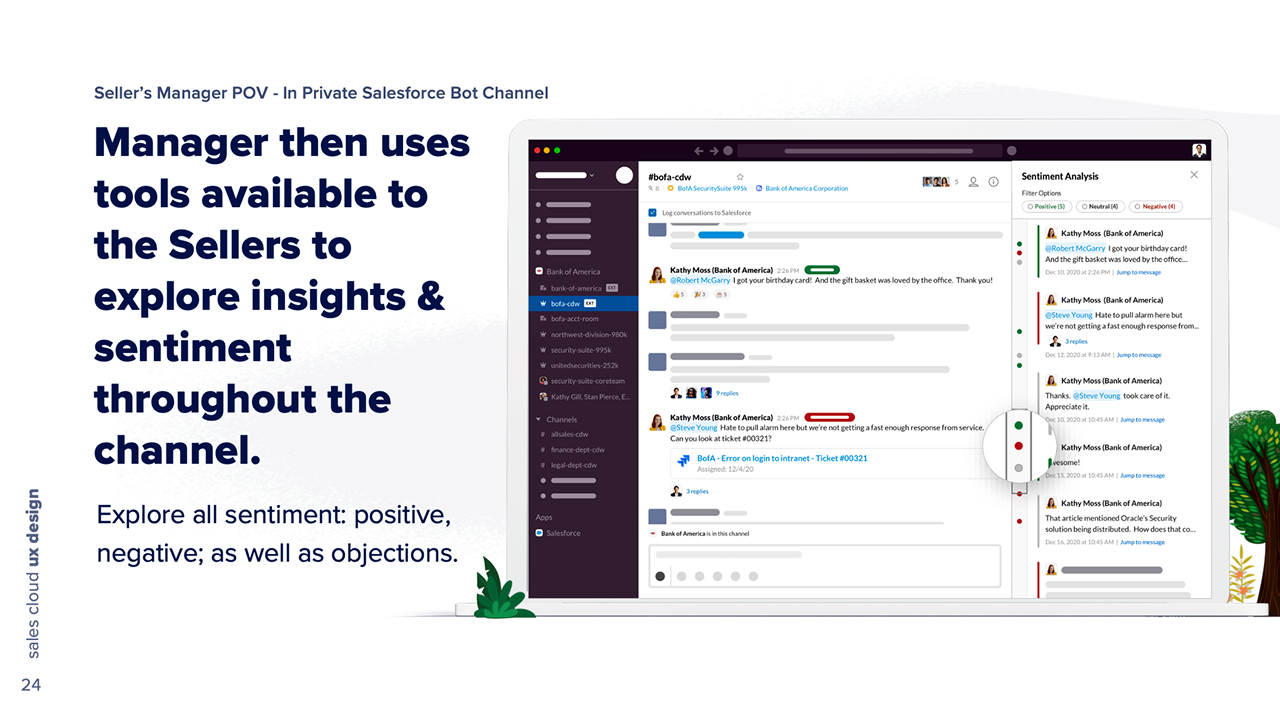
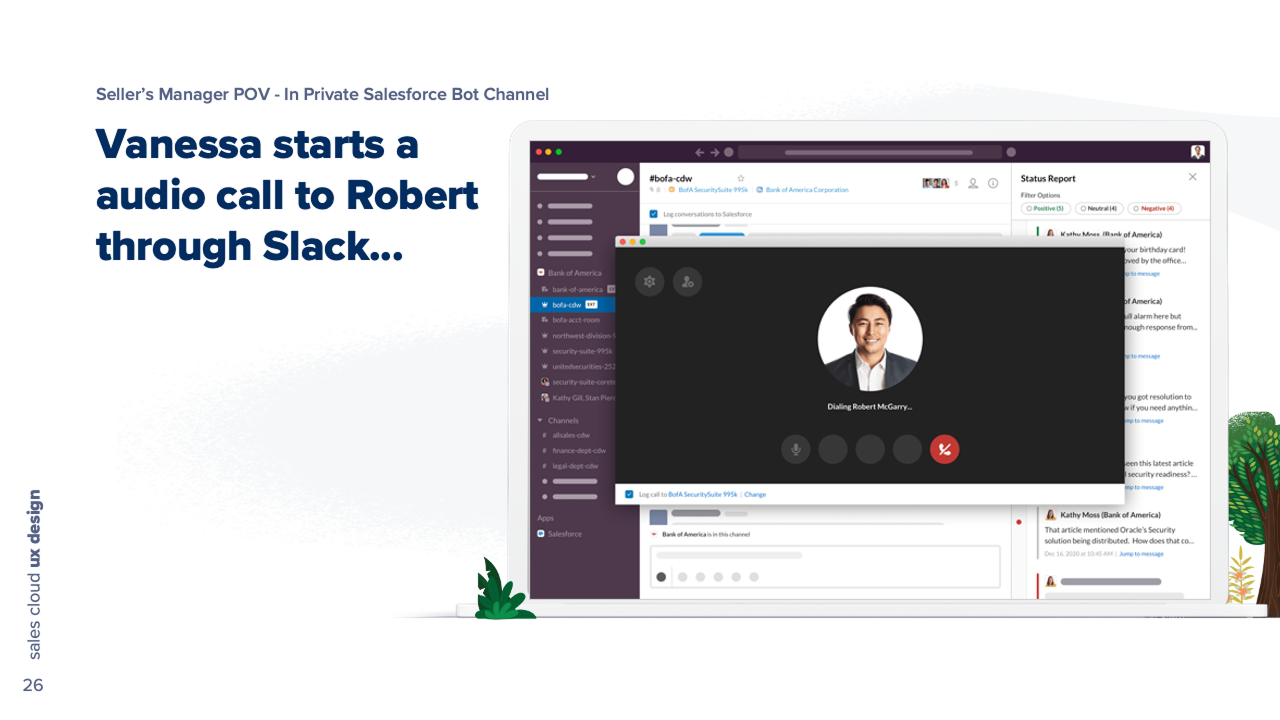
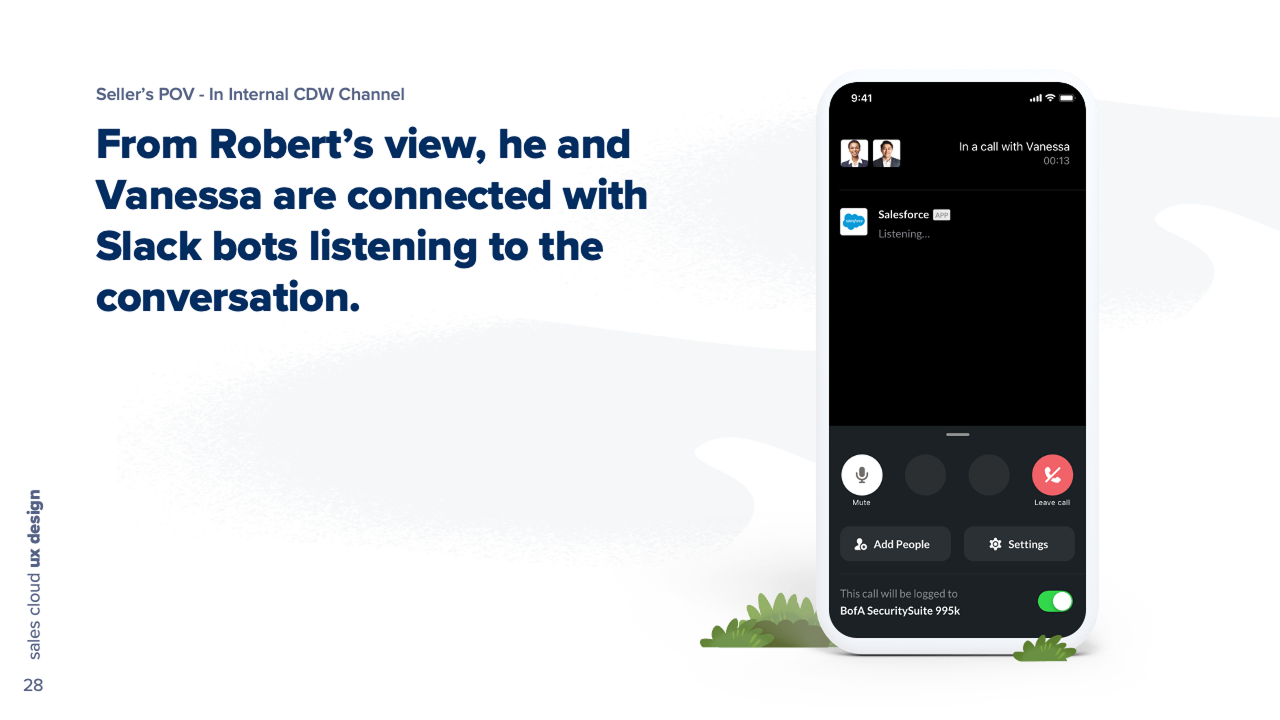
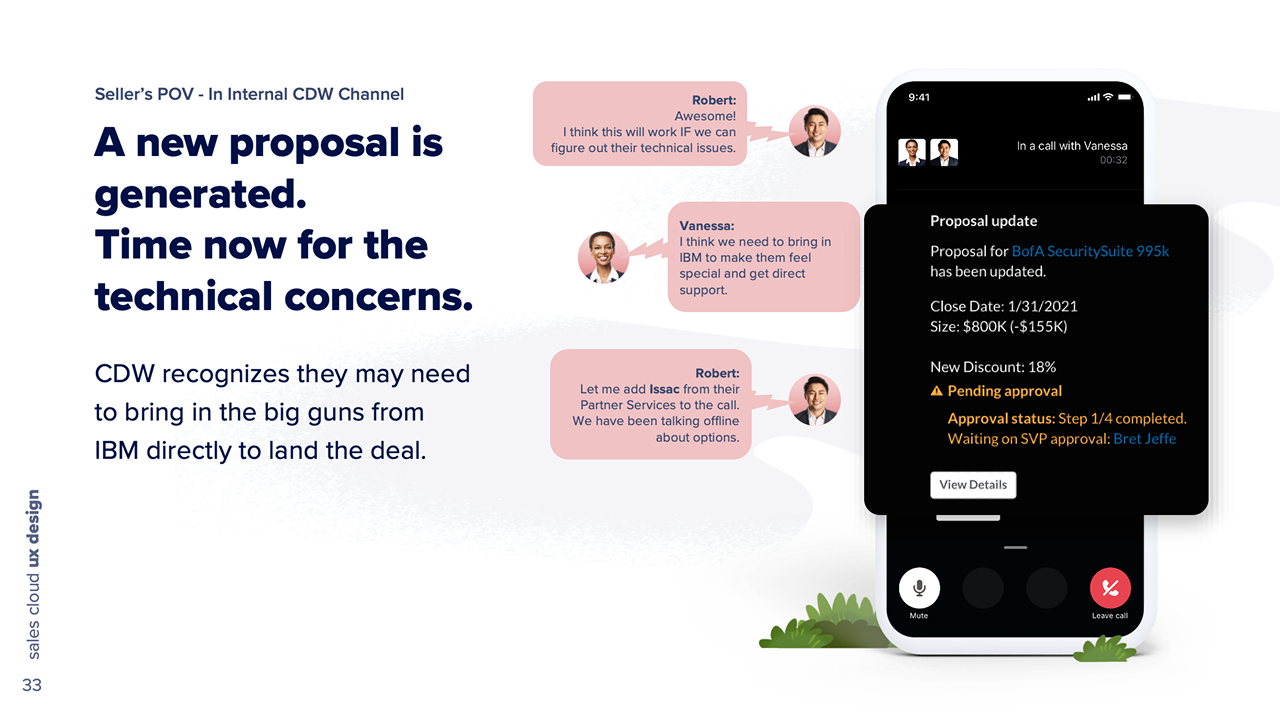
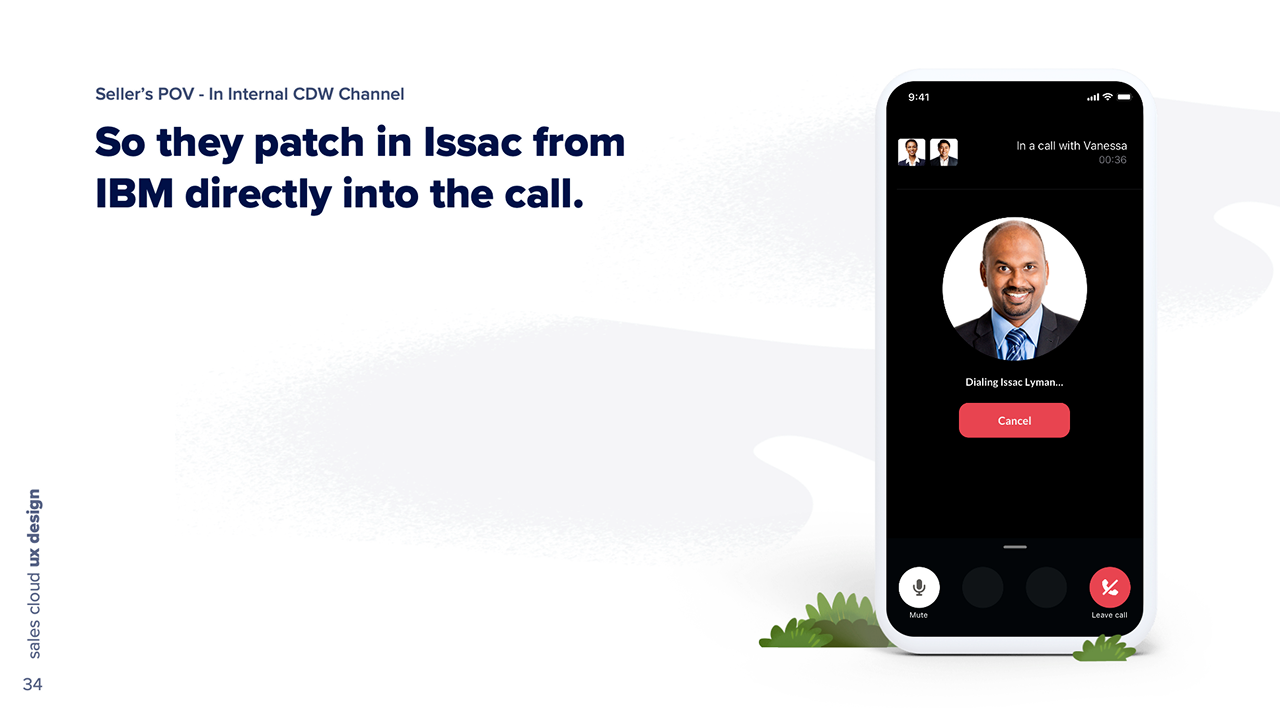
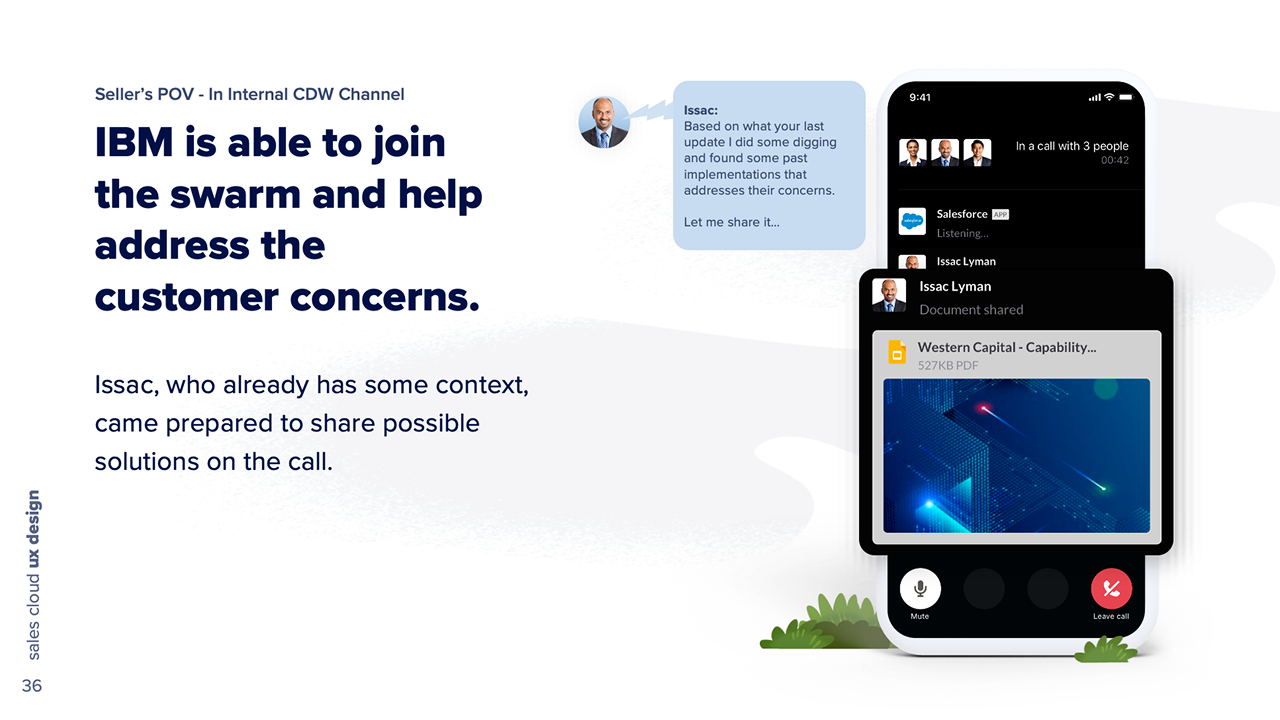
The manager gets the alert framed against her own commit, digs into the signals, and calls the rep. The call becomes a working surface: bots listen, offer options, and write the outcome back to the deal.
Act Three: The Close
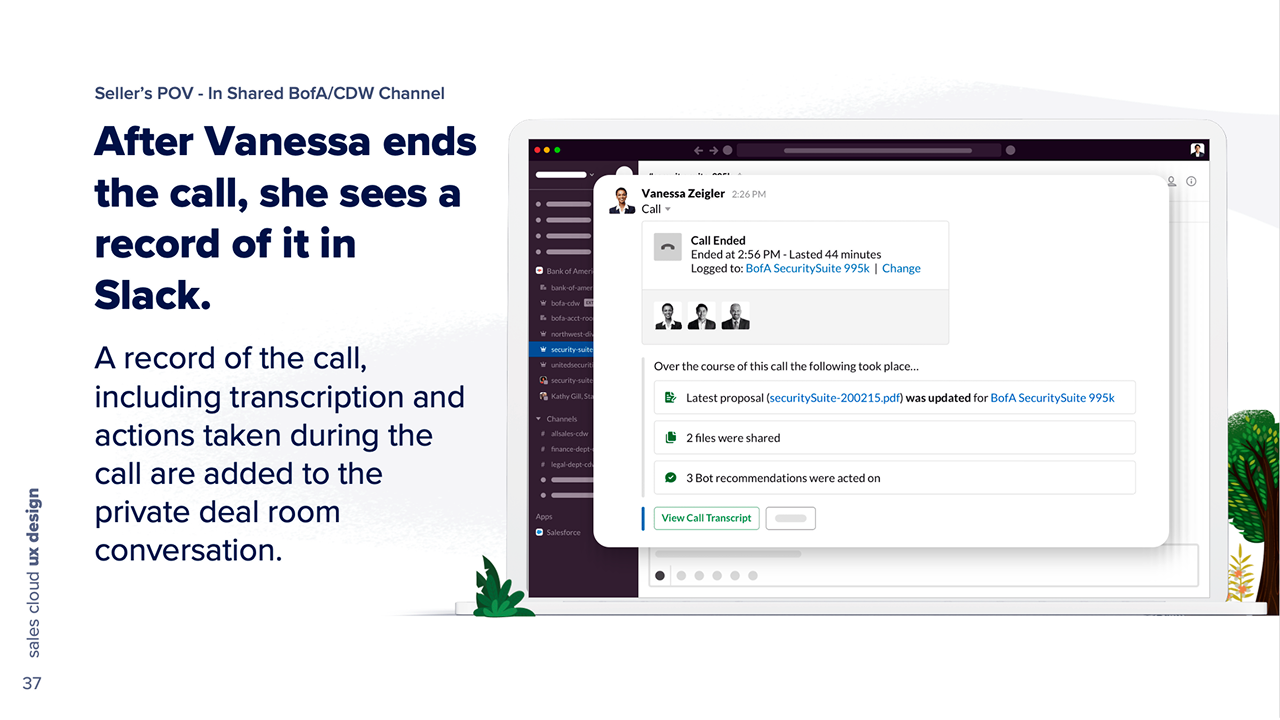
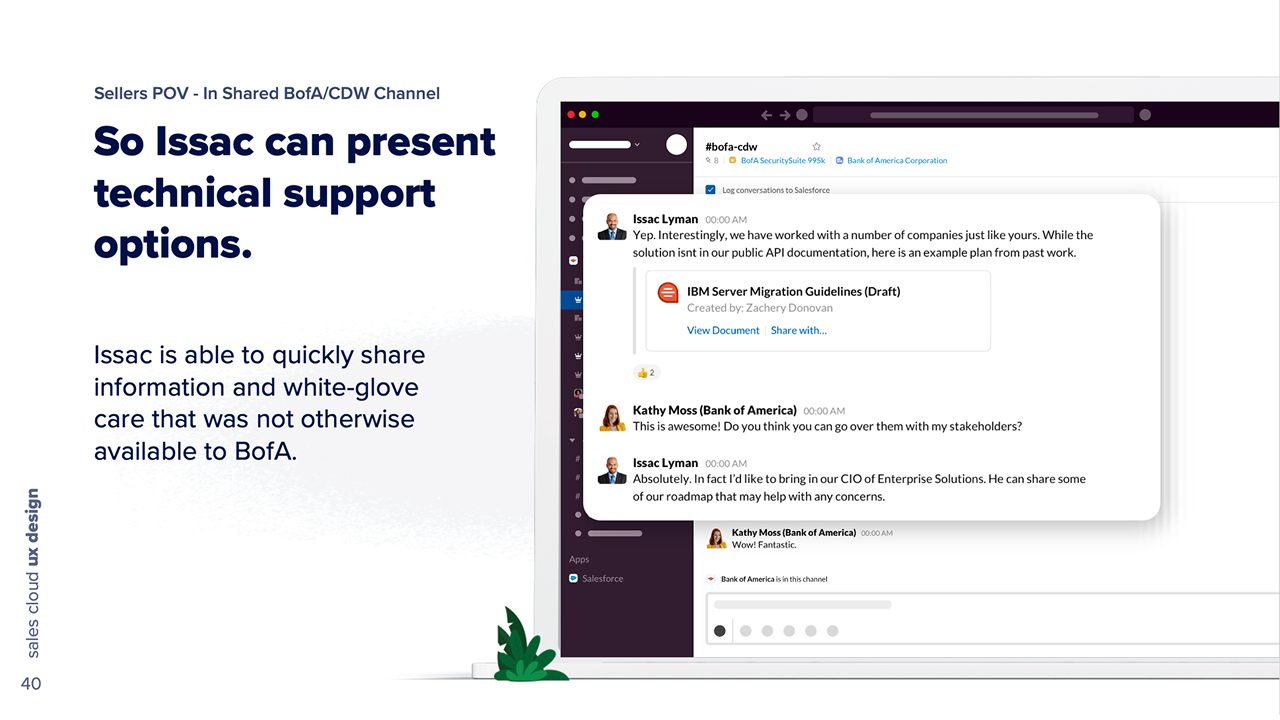
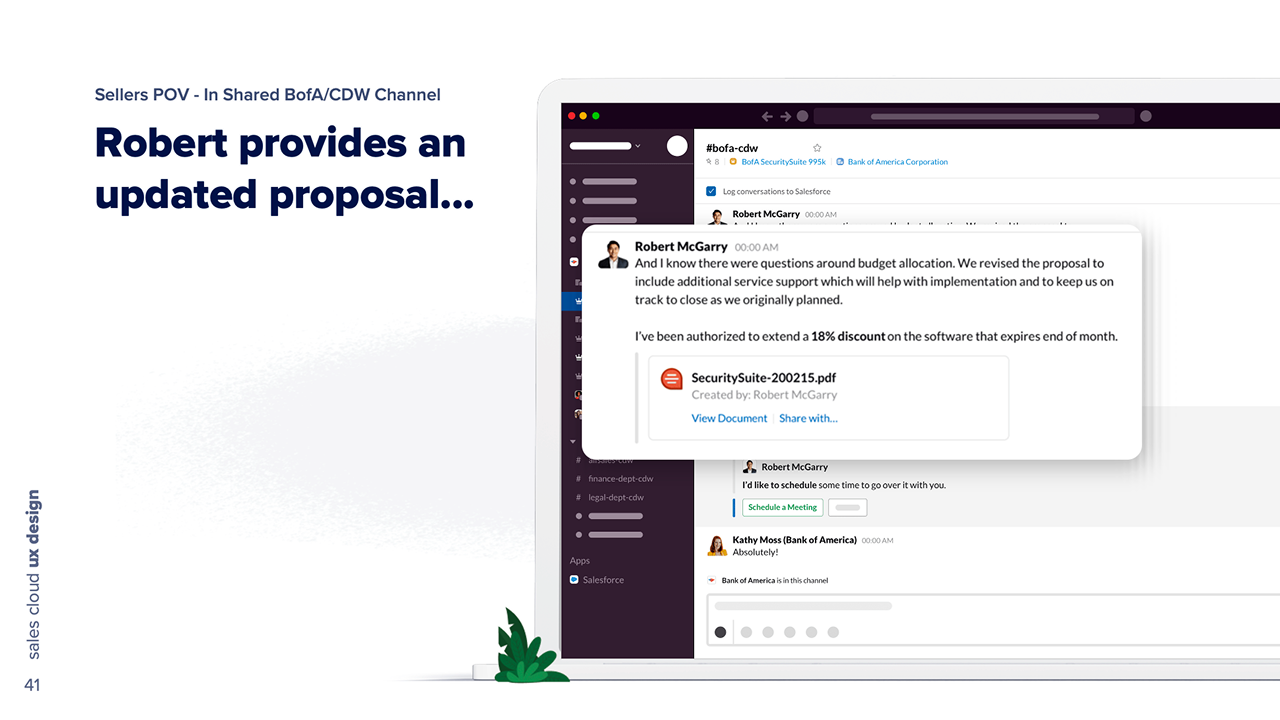
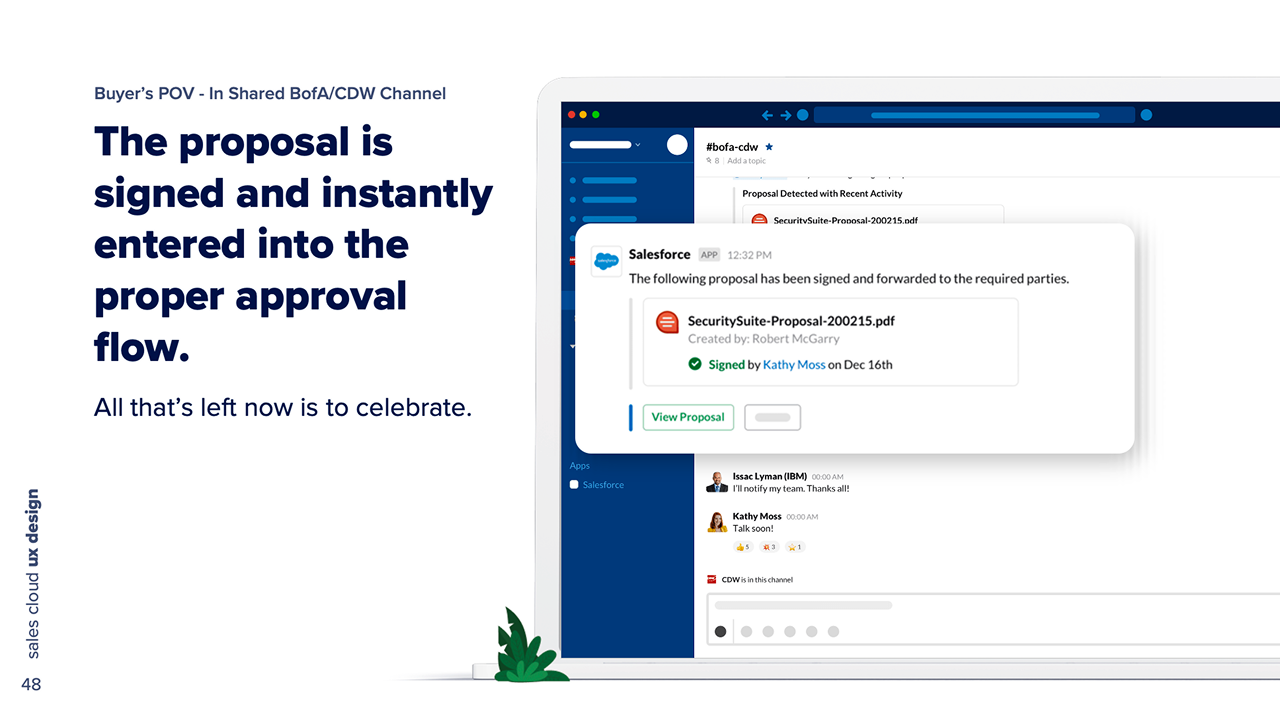
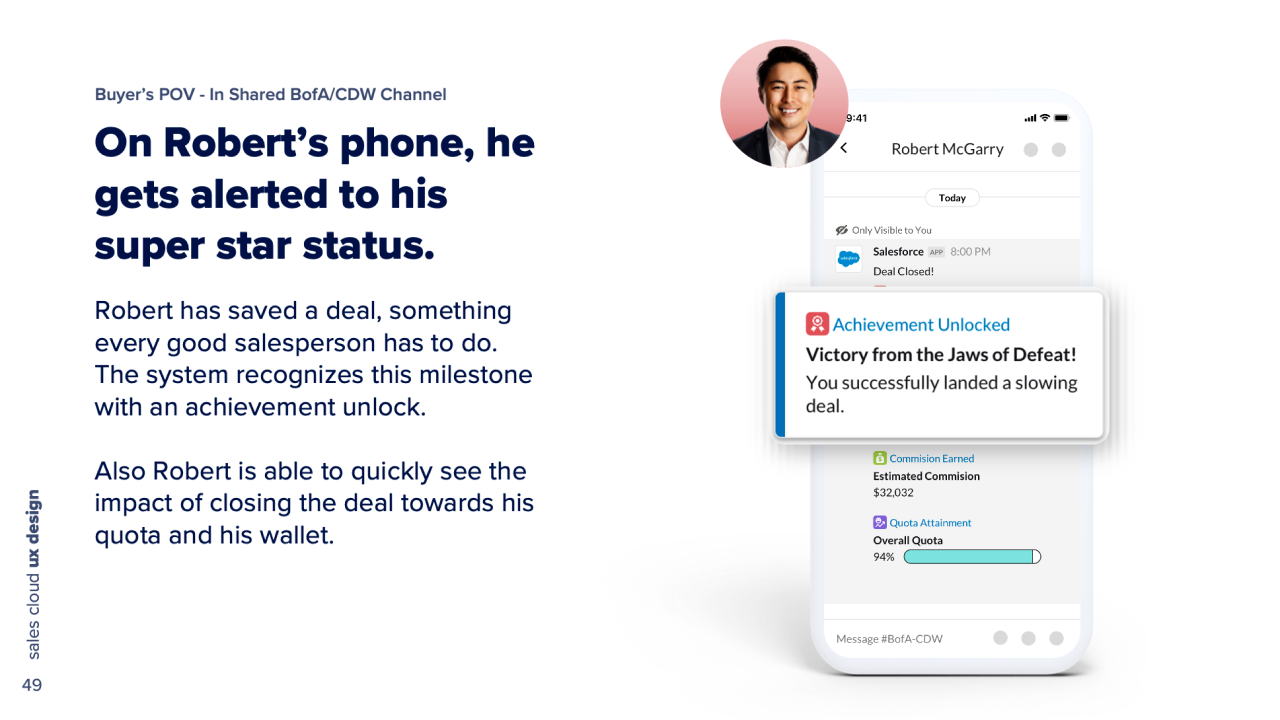
The partner comes into the channel shared with the customer, the revised proposal lands, scheduling and signature collapse into the conversation, and the close is recognized on the rep’s phone.


What the Exploration Argued
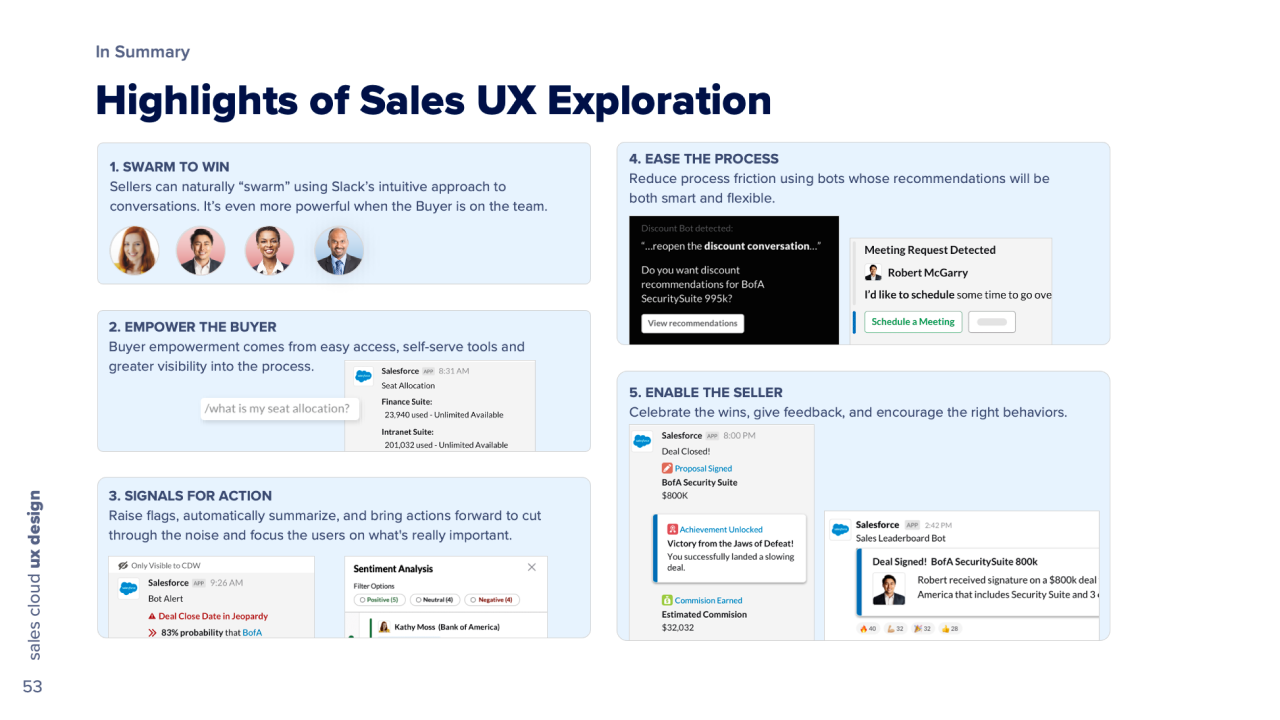
A narrative persuades but is hard to act on. I closed by pulling the story into five claims, each traceable to a moment the audience had just seen, so the discussion afterwards had something to hold.
In summary
The closing slide. Five claims, each anchored to a screen the audience had just seen.
Swarm to win
Sellers already swarm on a troubled deal. Slack makes it native rather than improvised, and more powerful still when the buyer is in the same channel.
Empower the buyer
Give the buyer self-serve access and real visibility. Every question she can answer herself is one that does not wait on the seller.
Signals for action
Raise flags, summarize automatically, and bring the action forward. Intelligence earns its place only when it points at something to do.
Ease the process
Discounting, scheduling, and signature are friction, not selling. Bots should absorb them, and their recommendations have to be smart and easy to override.
Enable the seller
Celebrate the wins, give feedback in the moment, and encourage the behaviors the organization wants repeated.
Impact and Reflection
It started the conversation it was built to start
It gave Sales Cloud leadership something specific to react to while the acquisition was still an abstraction, and the five principles became shorthand the team used in later discussions about Slack and Sales Cloud together.
It set up the next waves of exploration
The deal-save scenario covered a deliberately narrow slice, and it pointed at the two areas we took up next: account management, with deal rooms inside an account hierarchy, and seller presence across public and private surfaces.
The bots in this story were agents
Every one of them is what the industry now calls an agent: scoped to a single job, triggered by intent in the conversation, acting on the record rather than reporting on it. We arrived at that shape by asking what a seller needs in the moment, not by chasing a category that did not exist yet. That is the part I would trust again, and the concept reads better today than it did the week I presented it.
Naming the ethics questions mattered more than answering them
We put the uncomfortable questions on the slides where they came up rather than in an appendix: whether the buyer’s self-serve activity should feed the seller’s strategy, and how seller-only insight sits honestly in a channel the customer is in. I would not soften that today. A concept that hides its own hard questions is not worth presenting.
What I would do differently
The story is told almost entirely from the seller’s side. The buyer is present, but the exploration never asks what she would want from a channel her vendor is instrumenting. Given another week, I would have built her half of the narrative with the same care.